

Gross margin
--
Free · Instant · No signup
Convert markup on cost to gross margin on price, and the reverse, with dollar examples.
Page updated 2026-09-04.
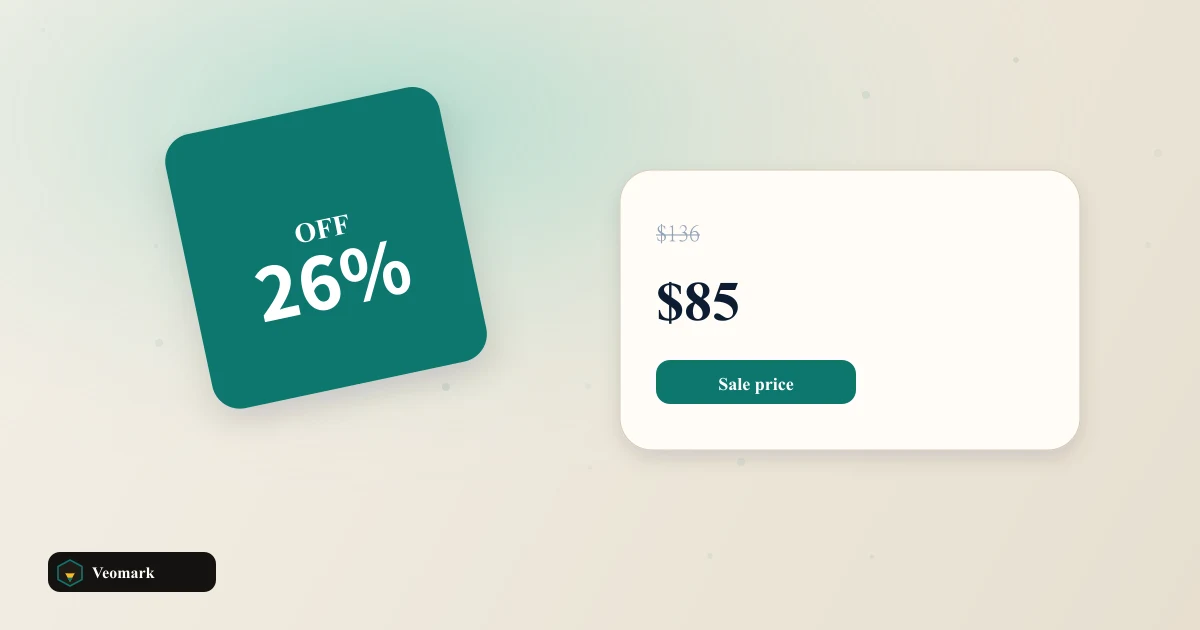

Gross margin
--
Markup on cost
--
Gross profit
--

A $40 unit cost sold at $65 generates $25 in gross profit -- but that $25 is 38.46% margin (profit / selling price) and 62.5% markup (profit / cost) at the same time. Same dollars, two different percentages, because each divides by a different base.
This is the single most common pricing mix-up in retail and wholesale conversations: someone says '60% markup' meaning cost-plus pricing, someone else hears '60% margin' meaning nearly two-thirds of the sale price is profit -- and prices a product 20+ percentage points wrong as a result.
The two numbers converge only at very low percentages and diverge more as they grow: a 100% markup is always exactly 50% margin, but a 200% markup is 66.7% margin, not 100% -- the relationship isn't linear.
Margin is on selling price. Markup is on cost. They are not interchangeable labels. Margin % = (price - cost) / price x 100. Markup % = (price - cost) / cost x 100. Both use the same numerator ($25 profit here) but different denominators.
If you know the markup you want and need to find the resulting margin (or vice versa), the two convert directly: margin = markup / (1 + markup), and markup = margin / (1 - margin), both expressed as decimals.
Cost and price are the only two inputs -- there's no separate discount, tax, or fee field, so build those into the cost or price figures before comparing across products.
Wholesale and retail pricing conversations use markup and margin almost interchangeably in casual speech but very differently in a spreadsheet -- the Wholesale Pricing & Markup Calculator works specifically from a target markup instead of margin.
For a business-wide view instead of a single SKU, the Gross Profit Margin Calculator applies the same margin definition across total revenue and COGS.
Because margin divides profit by selling price ($25/$65 = 38.46%) while markup divides the same profit by cost ($25/$40 = 62.5%). Same dollar profit, different denominator, different percentage.
50% markup converts to margin / (1 - margin) = 0.5, solving to a 33.3% margin -- not 50%. Use margin = markup / (1 + markup) to convert: 0.5 / 1.5 = 0.333.
No. A 100% markup means selling at double the cost, which works out to exactly 50% margin. A 100% margin is mathematically impossible (it would mean the cost is $0), which is one reason mixing up the two terms causes real pricing errors.
Margin is on selling price. Markup is on cost. They are not interchangeable labels. Retailers often think in margin (since it ties directly to revenue), while some wholesale and manufacturing pricing is built from markup on cost -- use whichever matches how your business already tracks profitability, but never assume the two numbers are close to each other.
No. It's a pure cost-vs-price conversion. Build any tax, discount, or processing fee into the cost or price figures before entering them if you want those reflected in the margin and markup shown.
 SaaS Rule of 40 Benchmark Calculator Growth plus profit margin versus the Rule of 40 line, with the gap in points.
  Crypto Dollar-Cost Averaging (DCA) Return Estimator Average cost and paper P/L from equal buys over N periods at a start and end price path.
  Etsy Listing Fee Renewal Estimator Monthly listing cash from active listings, $0.20 auto-renews, and optional auto-renew on sale.
  PayPal Fee Calculator Exact net, gross, and invoice amount after PayPal fees.