

Break-even months
--
Free · Instant · No signup
Months to recoup closing costs and lifetime interest saved versus keeping the current loan.
Page updated 2026-09-14.

Break-even months
--
Current payment
--
New payment
--
Monthly payment change
--

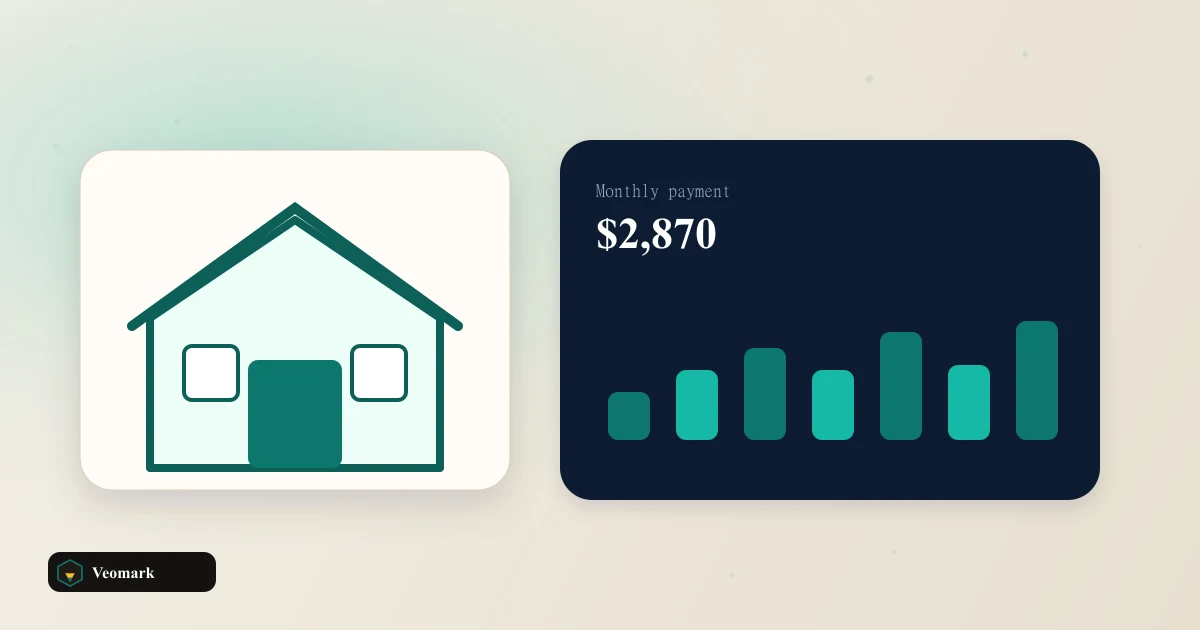
Refinancing a $280,000 balance from 6.75% (with 312 months left) to a new 5.75% loan over a fresh 360-month term drops the payment from $1,906.22 to $1,634.00 -- a monthly savings of $272.22. Against $4,500 in closing costs, that pays for itself in 16.53 months, or a little under a year and a half.
Break-even months = closing costs / monthly savings: $4,500 / $272.22 = 16.53. If you plan to stay in the home (or keep the loan) longer than 16.53 months, this refinance is a net gain; sell or refinance again before that point and the closing costs weren't recovered.
Part of the savings here also comes from resetting the term back to 360 months instead of continuing the original loan's remaining 312 -- stretching the term lowers the payment independent of the rate drop, so some of this $272.22 is a term effect, not purely a rate effect.
Compares two fixed P&I loans. Points and cash-out are not modeled separately. If you're paying points to buy down the new rate or pulling cash out in the refinance, add those costs into the closing-costs field to get an accurate break-even.
If the new payment isn't actually lower than the old one, the calculator flags that the break-even period is undefined rather than showing a misleading number -- a refinance with a higher payment never 'breaks even' on payment savings.
Resetting to a full new 360-month term (as in this example) recovers costs faster on paper but extends how long you're paying interest overall; compare total interest on the Mortgage Payment & Amortization Calculator for both the old and new loan to see the full trade-off.
If points are on the table as a way to buy the rate down further, the Mortgage Points Break-Even Calculator handles that specific trade-off.
The same break-even logic applies to student loans -- see the Student Loan Refinance Savings Calculator if that's the debt you're refinancing instead.
Break-even months = total closing costs / monthly payment savings. Here that's $4,500 / $272.22 = 16.53 months -- the point at which cumulative payment savings equal what you spent to refinance.
The calculator returns a message that break-even is undefined. A refinance only 'breaks even' on payment savings if the new payment is actually smaller than the old one -- a higher payment never recovers closing costs through monthly savings alone.
Partly. Some of the $272.22 monthly savings comes from stretching back to a full 30-year term rather than the 312 months remaining on the original loan, not purely from the lower rate. Set the new-term field to match your remaining term if you want to isolate the rate effect.
Not automatically. Compares two fixed P&I loans. Points and cash-out are not modeled separately. Add any points cost or cash-out amount into the closing-costs field yourself if they apply to your refinance.
Only if you keep the loan (or stay in the home) past that point. Selling, paying off, or refinancing again before the break-even month means the closing costs were a net loss.
 Mercari Fee & Net Earnings Calculator Seller net after Mercari selling fee and shipping you cover versus buyer-paid labels.
  Product Packaging Box Dimension & Shipping Weight Calculator Dimensional weight versus actual weight so you can see which one a carrier will bill.
  Shopify Profit Margin Calculator Plan-tier gateway fees, COGS, and ads vs profit per item and monthly net.
  Freelance Rate & Project Scope Calculator Hourly, daily, and project quotes after tax, PTO, overhead, and profit margin.