

CPM
--
Free · Instant · No signup
Convert among CPM, CPC, and CTR when any two of the three (or spend and outcomes) are known.
Page updated 2026-09-04.
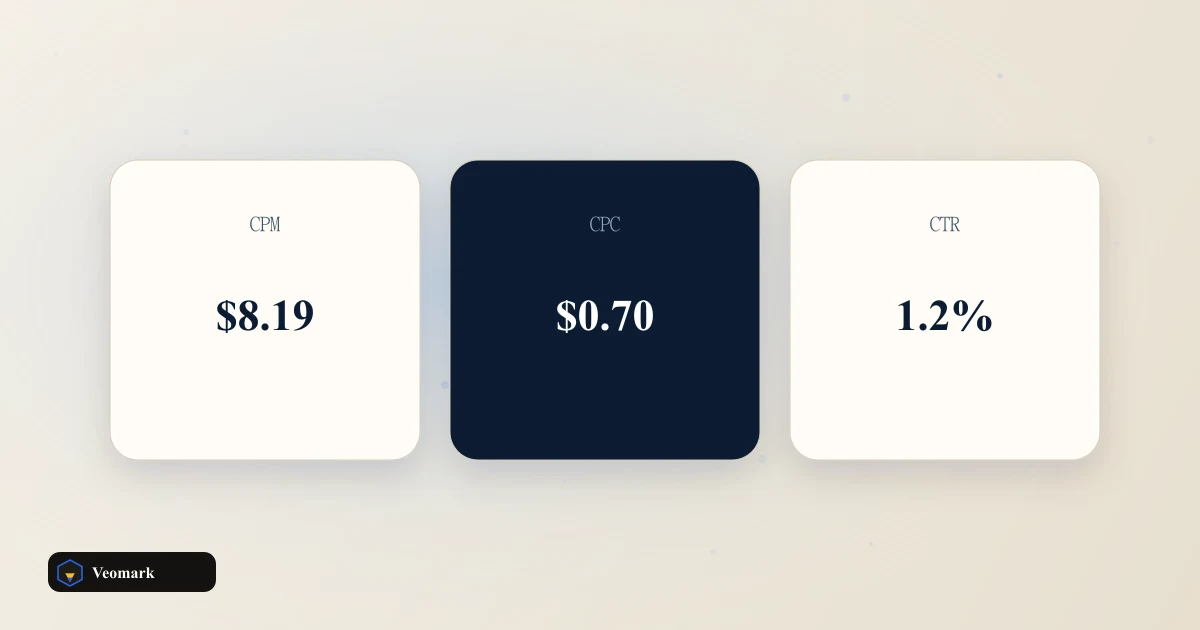

CPM
--
CPC
--
CTR
--

100,000 impressions, 1,800 clicks, and $450 in spend produce a CPM of $4.50 (spend / impressions x 1,000), a CPC of $0.25 (spend / clicks), and a CTR of 1.80% (clicks / impressions x 100).
These three metrics are mathematically linked, not independent: given any two, the third is determined. CPC = CPM / (10 x CTR%) is the identity connecting all three here -- $4.50 / (10 x 1.8) = $0.25, confirming the relationship holds regardless of which two numbers you start from.
Because they're linked, comparing campaigns on CPM alone (or CPC alone) without also checking CTR can be misleading -- a campaign with a low CPM but also low CTR can have a worse CPC than a higher-CPM campaign with strong engagement.
CPC = CPM / (10 x CTR%). Identity only. Platforms define viewability differently. This calculator confirms the arithmetic relationship between three numbers you already have -- it doesn't tell you whether $4.50 CPM or 1.8% CTR is good or bad for your specific industry, platform, or ad format, which varies enormously.
'Impressions' itself is defined differently across ad platforms (viewable impression standards, in-view time thresholds) -- comparing CPM across platforms using self-reported impression counts can compare apples to oranges if the underlying impression definitions differ.
This uses whatever spend, impressions, and clicks you enter for a single campaign or period -- it doesn't distinguish between click quality (a click that bounces immediately vs. one that converts), which matters more for actual ROI than CTR alone.
Once clicks arrive, what happens next (lead or sale conversion) is where the real ROI question lives -- see the Cost Per Lead & Conversion Calculator for that next step.
For a platform-specific CPC bidding context, the Google Ads CPC Bid Calculator applies this same relationship to bid-setting decisions.
CPM = spend / impressions x 1,000 = $450 / 100,000 x 1,000 = $4.50. CPC = spend / clicks = $450 / 1,800 = $0.25. CTR = clicks / impressions x 100 = 1,800 / 100,000 x 100 = 1.80%.
It's a rearrangement of the same underlying numbers: $4.50 / (10 x 1.8) = $4.50 / 18 = $0.25, matching the directly calculated CPC. Given any two of the three metrics, the third can always be derived this way.
CPC = CPM / (10 x CTR%). Identity only. Platforms define viewability differently. This calculator doesn't judge that -- CPM benchmarks vary enormously by platform, industry, audience targeting, and ad format. Compare against your own historical campaigns or industry-specific benchmarks, not a universal number.
Because platforms don't always define 'impression' identically -- viewability standards (how much of an ad must be visible, for how long, to count) differ, so the same actual ad exposure can be counted differently depending on the platform's measurement methodology.
Not necessarily. This calculator measures clicks, not what happens after the click. A high CTR with poor post-click conversion can still produce a worse overall return than a lower CTR campaign with strong conversion -- check that with a cost-per-lead or conversion-rate tool.
 Amazon Product Keyword Density Analyzer Word frequency in a listing block so you can see which tokens dominate.
  TikTok Money Calculator Views, gifts, and creator-fund estimates.
  YouTube RPM & Revenue Calculator AdSense RPM/CPM by niche and geo, Shorts vs long-form, extra streams.
  Podcast Sponsor CPM & Earnings Estimator Host-read estimate from downloads, CPM, and reads per episode across a month.